Wine Cooler vs Regular Refrigerator: What Is the Difference?
A regular refrigerator is a good place to chill a bottle you plan to open in the next day or two, but it is the wrong place to keep wine for months. It runs too cold, the air inside is dry, the compressor and the door both shake things up, and the wine shares space with strong-smelling food. A wine cooler holds a warmer, steadier temperature designed for wine and gives bottles a quiet, dark place to rest on their sides.
Why a Kitchen Fridge Is Too Cold
Food safety guidance calls for a refrigerator at or below 40F (4C), and most run somewhere around 37 to 40F (3 to 4C). That is right for milk and leftovers. For wine storage, the usual recommendation is around 55F (13C).
At fridge temperatures, a wine’s development slows almost to a stop, which matters if you bought a bottle to improve with age. Very cold wine also tastes muted. Aromas are harder to pick up and reds can taste harsh and thin straight from the fridge. Our guide to serving temperatures explains how much a few degrees changes a glass.
Dry Air and Corks
A refrigerator removes moisture from the air as it cools, which is part of how it keeps food from spoiling. Over a few weeks, that is unlikely to matter. Over many months, dry air can dry out the outside of a natural cork, and a shrunken cork lets more air reach the wine. Wine storage guidance commonly suggests humidity somewhere around 50 to 70 percent. Our article on wine cooler humidity goes into how coolers handle this.
Screw-cap bottles are not affected by humidity, so this point mainly applies to wines sealed with a cork.
Vibration, Light and the Door
Every time you open a fridge door, the bottles in the door shelf get jostled and the inside temperature swings. A family kitchen fridge might be opened many times a day. Add the compressor cycling on and off and the wine never really sits still.
There is also the light. Each door opening floods the inside with light, and wine is sensitive to prolonged light exposure, which is one reason many bottles come in tinted glass. A single fridge light is a minor issue on its own, but it adds to the case against long-term storage.
Odors
Fridges hold onion, cheese, leftovers and everything else in the kitchen. Wine sealed under a cork is well protected, and there is not much good evidence that a few weeks next to a cut onion will taint a bottle. The concern grows with time, though, and it is one more reason a fridge is better treated as a short stop than a home for wine.
What a Fridge Is Fine For
None of this means you should keep wine out of the fridge entirely. It is the right tool for:
- chilling a white, rosé or sparkling wine for tonight (a few hours on a shelf usually does it)
- giving a fuller red a short chill, around 20 to 30 minutes, before serving
- keeping an opened bottle fresh for a few more days (see how long wine lasts after opening)
Store the bottle on a main shelf instead of the door to avoid the worst of the jostling.
What a Wine Cooler Does Differently
A wine cooler is built around the needs of a sealed bottle rather than a carton of eggs:
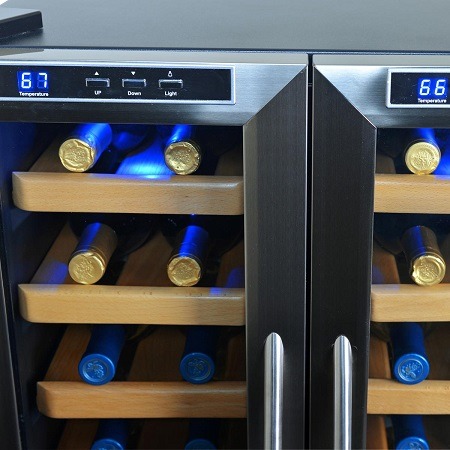
- Warmer, adjustable temperature. Most models cover something like the mid 40s to the mid 60s Fahrenheit, which spans both long-term storage at around 55F and serving temperatures.
- Steadier conditions. It is opened far less often than a kitchen fridge, so temperature swings are smaller.
- Horizontal racks. Bottles lie on their sides, which keeps the cork in contact with the wine.
- Darker interior. Many glass doors are tinted or treated to cut down on UV light, and interior lights are usually switched on only when you want them.
- Less vibration. Thermoelectric models have no compressor at all, and many compressor models are built to reduce vibration.
Our wine coolers guide covers the main types if you are starting from scratch. If a cooler is not in the budget yet, how to store wine without a wine cooler has practical options using a closet or basement.
If you do end up keeping a few bottles in the kitchen fridge for a while, lay them flat on the lowest main shelf toward the back, where the temperature tends to be steadiest and the door does not reach them, and plan to drink them within a few months.