Wine Cooler Humidity: How Much It Matters and How to Fix It
The humidity range most often recommended for wine storage is roughly 50 to 70 percent relative humidity, with some sources narrowing it to around 60 to 70 percent. It matters mainly for cork-sealed bottles you plan to keep for several years. If you drink most of your wine within a few months, or it comes with a screwcap, humidity is a minor concern next to temperature.
Why humidity matters at all
The concern is the cork. Natural cork is a bark product, and over a long period in very dry air the exposed end of it can dry out and shrink slightly. A shrunken cork can let a little air in and a little wine out. Over years, that can lead to oxidation (the wine tastes flat, nutty or sherry-like when it shouldn’t) and a lower fill level in the bottle.
This is a slow process. It plays out over years of storage, not weeks, which is why humidity advice comes mostly from people building cellars for long-term aging.
When you can mostly ignore it
- Bottles you’ll open within a year or so. Normal indoor humidity is very unlikely to cause a problem in that time.
- Screwcaps. A screwcap doesn’t dry out, so the surrounding humidity has little effect on the seal.
- Synthetic corks and glass stoppers, which don’t depend on moisture the way natural cork does.
Most wine sold is made to be drunk young anyway. The bottles that benefit from careful humidity control are the ones you are holding for years to let them develop.
If that describes your collection, focus on keeping the temperature steady. A wine cooler holding around 55°F (13°C) without big swings is doing most of the work already.
What happens if it’s too dry or too damp
Too dry (well under 50 percent for long periods). The risk is the cork drying from the outside, as above. In a home this is most likely in winter when the heating runs constantly, or in very dry climates.
Too damp (well over 70 to 80 percent). The wine itself is fine, but the packaging suffers. Paper labels can wrinkle, stain, peel or grow mold, and mold can also form on the top of the cork under the capsule. Surface mold on the outside of a cork usually doesn’t affect the wine, but it looks bad and can hurt resale value if you collect. Constant dampness can also encourage mold on wooden shelves and on the door seal.
Inside a wine cooler, the more common problem tends to be the damp side: condensation on the back wall, water pooling at the bottom, or a musty smell. That usually points to a blocked drain, a door that isn’t sealing, or the door being opened a lot in a humid room. Our guide on how to clean a wine cooler covers dealing with mold and odors.
How to check and adjust humidity
Measure first. A small digital hygrometer (a humidity meter) is inexpensive and fits on a shelf. Leave it inside for a day or two with the door closed before trusting the reading, since opening the door changes it.
If it’s too dry:
- Put a small dish or cup of water on the bottom of the cabinet. Refill it as needed and clean it regularly so it doesn’t grow mold.
- Some coolers have a built-in water tray or a holder for porous stones meant to hold moisture. Check the manual for what yours has and how often to refill it.
- Keep door openings short. Each one swaps the air inside for room air.
If it’s too damp:
- Remove any water dish you’ve added.
- Check that the drain hole at the back of the cabinet isn’t clogged, and that the door gasket seals all the way around. A common check is to close the door on a sheet of paper and see if it slides out easily.
- Wipe up standing water and leave the door open briefly to air the cabinet out after cleaning.
- Make sure the cooler has the ventilation clearance the manual asks for. A unit that struggles to shed heat runs longer, which can change how much moisture collects inside.
Built-in humidity control varies a lot between models. If it matters to you, look in the spec sheet or manual for a humidity feature rather than assuming every cooler has one. For a broader look at what different coolers offer, see our wine coolers guide.
Why bottles are stored on their side
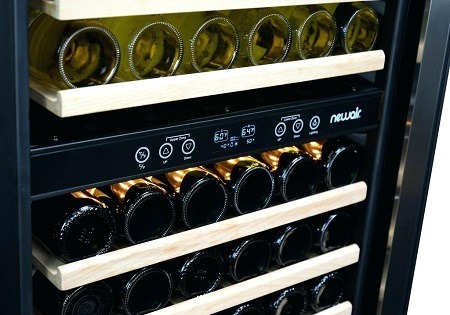
Laying a cork-sealed bottle on its side keeps the wine in contact with the inner end of the cork, which is the traditional way to keep the cork from drying out. Most wine cooler racks are designed for horizontal storage for that reason, and it also saves space.
There is some debate about how much this matters, since the air gap inside a sealed bottle stays very humid on its own. Some researchers argue the cork stays moist either way. Storing bottles on their side still costs nothing, though, so it remains the standard advice for anything you plan to keep for a while.
Screwcap bottles can be stored either way. Many people store them on their side anyway simply because that’s how the rack is built.
One check worth doing
Look at the fill level of any bottle you’ve been keeping for several years. If the wine has dropped noticeably into the shoulder of the bottle compared with similar bottles, or there is a sticky residue around the top of the capsule, the seal may be leaking. That bottle is a good one to open sooner rather than later.