How to Store Wine Without a Wine Cooler
You don’t need a wine cooler to store wine well for a few months. Find the coolest spot in your home that stays at a steady temperature, is dark, and isn’t next to anything that vibrates or gives off heat, then lay cork-sealed bottles on their side. An interior closet or a basement usually does the job.
Here is how to pick that spot and what to avoid.
The four things that damage wine
Heat. Warmth speeds up the chemical changes in wine. The temperature usually cited as ideal for storage is around 55°F (13°C), but anything that stays roughly between 50 and 65°F is generally fine for most home storage. Long stretches above about 70°F (21°C) age wine faster than intended, and a bottle left somewhere very hot, like a car or attic in summer, can end up tasting stewed or flat.
Temperature swings. Many experts consider a steady temperature more important than hitting an exact number. When wine warms and cools repeatedly, it expands and contracts. Over time that can push on the cork and draw air in. A spot that holds 65°F year-round is better than one that bounces between 50 and 75°F.
Light. Sunlight and strong artificial light, especially UV, can damage wine over time. Clear and pale-colored bottles (many whites, rosés and sparkling wines) are the most exposed. Dark green and brown glass gives more protection but doesn’t block everything.
Vibration. Constant shaking is widely thought to disturb wine during long aging, though the effect from normal household vibration is probably small. It is still an easy thing to avoid: don’t keep bottles on top of a washer, dryer or refrigerator.
The best spots in a typical home
An interior closet. A closet on an inside wall, away from heating vents and sunny rooms, is often the most stable space in a house or apartment. A low shelf or the closet floor is better than a high shelf, because warm air rises.
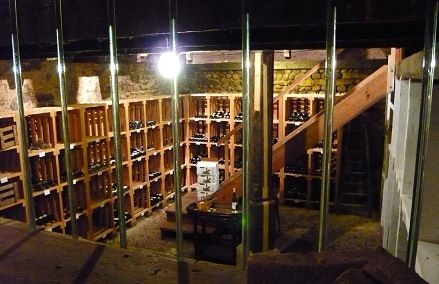
The basement. Below-ground rooms tend to stay cooler and more even than the rest of the house, which is why traditional cellars are underground. Check that the area isn’t next to the furnace or water heater, and watch for very damp corners where labels can grow mold.
Under the stairs. The storage space under a staircase is often enclosed, dark and on an interior part of the house.
Under a bed in a cool room. Not glamorous, but it is dark and usually away from appliances. Use a box or bin so bottles don’t roll.
Whatever space you choose, keep it away from exterior walls where possible, since those warm up and cool down with the weather.
The worst spots
The top of the refrigerator is one of the most common places people keep wine and one of the worst. Refrigerators release heat from their compressors and coils, and the top of the unit also picks up vibration.
Others to avoid:
- The kitchen near the stove, oven or dishwasher, which heat the room in bursts every day.
- The garage, unless it is insulated and climate controlled. Otherwise it tracks the outdoor temperature, which can mean freezing in winter and well above 80°F in summer.
- Sunny rooms and windowsills, where bottles get heat and light at the same time.
- Decorative wall racks above a radiator or heating vent. They look nice, but the bottles sit in the warmest air in the room.
Bottles on their side, and other small habits
Store bottles sealed with natural cork on their side so the wine stays in contact with the cork. Screwcap bottles can be stored upright or on their side.
A few other habits help:
- Keep bottles in the cardboard case they came in if you don’t have a rack. The box blocks light and stops bottles rolling.
- Don’t move bottles around more than you need to.
- Put a cheap thermometer in the spot for a week or two before committing. Check it in the morning and the evening. A reading that moves more than a few degrees a day suggests a better spot is worth looking for.
- Avoid the regular kitchen fridge for long-term storage. It is fine for chilling a bottle before serving, but it runs colder and drier than ideal for months of storage. See wine cooler vs regular refrigerator for the details.
How long wine keeps this way
For the kind of wine most people buy, meant to be drunk within a year or two, a cool, dark, steady spot at home is generally enough. Keeping bottles in an interior closet for a few months up to a year or so is unlikely to cause any noticeable change.
Storage without a cooler gets riskier if the spot runs warm (consistently in the 70s °F), if it swings with the seasons, or if you plan to age wine for many years. Wines meant for long aging are the ones that benefit most from proper cellar conditions.
Once a bottle is opened, the clock changes completely. Our guide on how long wine lasts after opening covers that.
When a wine cooler is worth it
A dedicated wine cooler starts to make sense when:
- You don’t have any spot that stays below about 70°F in summer.
- You keep more than a couple of cases at a time.
- You want to age some bottles for several years.
- You’d like whites and sparkling wine ready at serving temperature without chilling them in the fridge first.
If that sounds like you, our wine coolers guide explains the main types and how they differ.
Until then, a simple test helps: open a closet you’re considering on a hot afternoon and feel the air. If it feels noticeably warmer than the rest of the house, keep looking.