Thermoelectric vs Compressor Wine Coolers
Thermoelectric wine coolers are quiet, nearly vibration free and work well for a small collection in a room that stays at a normal indoor temperature. Compressor wine coolers cool more powerfully, hold their temperature in warm rooms and come in much larger sizes. If your space gets hot or you want more than a couple of dozen bottles, a compressor unit is usually the better choice.
How Each Type Cools
A thermoelectric cooler uses a solid-state module (often called a Peltier module). When electricity passes through it, one side gets cold and the other side gets hot. A small fan moves cold air into the cabinet, and a heat sink with a second fan pushes the heat out the back. There is no refrigerant and no compressor.
A compressor cooler works like a kitchen refrigerator. A refrigerant is compressed, releases heat through a condenser coil, then expands and absorbs heat inside the cabinet. The compressor switches on when the cabinet warms past the set point and off again once it is cool enough.
That difference in method explains almost every other difference between the two.
Noise and Vibration
With no compressor, a thermoelectric cooler makes very little noise beyond a soft fan hum, and it produces almost no vibration. That makes it a good fit for a bedroom, office or open-plan living space.
Compressor units make a low hum while running, and you may hear a click when the compressor starts or stops. Better models use mounts that dampen the motor, but some vibration is part of how they work. Many wine writers say constant vibration may disturb wine during long aging, though how much it matters in a home cooler is debated. For bottles you plan to drink within a year or two, it is unlikely to be a concern. We cover sound levels in more detail in how loud is a wine cooler.
The Room Temperature Problem
This is the limitation that catches many thermoelectric buyers out. A thermoelectric module can only move heat so far, so the cooler holds a temperature relative to the room rather than an absolute number. Many manufacturers describe their units as cooling to roughly 20F or so below the surrounding air, and the owner’s manual usually lists an ambient range the unit is designed for.
Here is what that means in practice:
- In a room at 72F (22C), reaching 55F (13C) for storage is usually fine.
- In a kitchen that reaches 85F (29C) on a summer afternoon, the same cooler may not get much below the mid 60s.
- In a hot garage, it may struggle to cool the wine much at all.
A thermoelectric unit also runs harder when the room is warm, and if the room drops close to the set temperature in winter, some models cannot warm the cabinet to compensate.
Compressor coolers handle warm rooms much better, but they still have limits. Most are designed for indoor, climate-controlled spaces. If you want one in a garage or basement that gets very hot or very cold, check that the manual covers that ambient range before you buy. If your cooler seems to run constantly and still feels warm, see our guide to a wine cooler not cooling.
Capacity and Placement
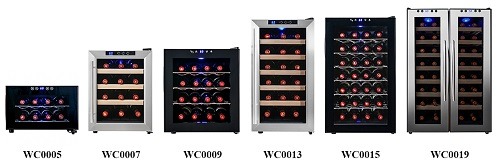
Because a single module can only remove a limited amount of heat, thermoelectric coolers are mostly small. Countertop and compact freestanding models in the 6 to roughly 30 bottle range are typical. Compressor units start small too but go all the way up to full-height cabinets holding well over a hundred bottles.
Placement differs as well. Thermoelectric coolers vent heat from the back and need open space behind and around them, often several inches, so they are freestanding only. Many compressor models are also freestanding, but front-venting compressor units are the ones designed to slide under a counter. If you want a built-in look, read built-in vs freestanding wine coolers before you shop.
Energy Use
In a cool room with a small load of bottles, a thermoelectric cooler can be fairly economical. The catch is that it tends to run continuously, and its efficiency drops as the room gets warmer and the gap it has to hold gets larger.
A compressor cycles on and off, and for larger cabinets or warmer rooms it is generally the more efficient way to move heat. As a rough rule, the bigger the cooler and the warmer the room, the more the advantage shifts toward a compressor. For a fuller breakdown, see wine cooler energy use.
Which One Should You Pick?
A thermoelectric cooler makes sense if:
- you have a small collection (roughly two dozen bottles or fewer)
- it will live in a room that stays comfortably cool year round
- quiet operation matters, for example in a bedroom or studio
A compressor cooler makes sense if:
- you want more capacity, or plan for your collection to grow
- the room gets warm, or the cooler will sit in a kitchen next to an oven
- you want a built-in, under-counter installation
- you need it to reach the low 40s for whites and sparkling wine in a warm house
Before you buy either type, find the ambient temperature range in the product manual or spec sheet and compare it with the warmest your room gets in summer. That one number tells you more about whether a cooler will work in your space than the bottle count or the temperature range printed on the box.