How Loud Is a Wine Cooler?

A working wine cooler is usually about as loud as a kitchen refrigerator, sometimes quieter. You will hear a low hum or fan whir, an occasional click when the cooling starts or stops, and now and then a gurgle. How noticeable that is depends mostly on the cooling type, where the unit sits, and how quiet the room is. In a busy kitchen most people stop hearing it; in a bedroom or home office, the same unit can be distracting.
Where the Noise Comes From
A few separate parts make sound, and knowing which is which helps you judge whether something is normal.
- The compressor. In compressor models this is the main source: a steady low hum while it runs. It switches on and off as the cabinet warms and cools, so the noise comes and goes rather than running all day.
- Clicks. A click when the compressor starts or stops is the thermostat or relay switching. One click at each cycle is normal.
- Fans. Most coolers have at least one fan, either to move air inside the cabinet or to push heat away from the cooling system. Fans make a soft whoosh or whir.
- Refrigerant. Gurgling, trickling or a faint hiss is refrigerant moving through the tubing. It is often most noticeable just after the compressor starts or stops.
- Cracks and pops. Plastic liners expand and contract slightly as the temperature changes, which can produce a small pop.
- Vibration. The compressor’s vibration can pass into a cabinet, a hard floor, loose racks, or bottles touching each other. This is often the most annoying sound, and the easiest to fix.
Thermoelectric vs Compressor Noise
Thermoelectric coolers have no compressor. They cool with a solid-state module and use a fan to clear heat from it, so there is no hum and no start-up click. That is why they are often recommended for bedrooms and living areas.
They are not silent, though. The fan runs for long stretches, and in a warm room it may barely stop at all. A cheap or aging fan can develop a whine or rattle that is more irritating than a compressor’s low hum. So “quieter” here means a different kind of sound: a steady, soft whir instead of a hum that cycles on and off.
Compressor coolers are usually still quiet enough for a kitchen, and many people find a cycling hum easier to tune out than a constant fan. They also cool far better in warm rooms. Our thermoelectric vs compressor wine coolers guide covers the other tradeoffs.
How to Read a Decibel Rating
Some manufacturers list a noise level in decibels (dB). It is a useful number, with a few caveats.
Decibels are logarithmic, not linear. A rough rule of thumb is that a 10 dB increase sounds about twice as loud to most people. So a gap of a few decibels between two models is smaller than it looks, while a gap of 10 or more is a real difference.
The bigger problem is that ratings are not always measured the same way. One brand may measure at a set distance in a test room, another may not say how it measured at all, and a figure may reflect only the quietest operating moment. Treat listed ratings as a rough guide, compare them only within the same brand where you can, and do not read too much into a model that lists no figure. Many simply do not publish one. Owner reviews that mention noise in a bedroom or open-plan space often tell you more.
If quiet operation matters a lot, it is worth checking that alongside capacity and zones in the best wine cooler buying guide.
Placement Tips That Cut Noise
Most noise complaints come down to how the cooler is installed rather than the cooler itself.
- Level it. Use a spirit level on top of the cabinet and adjust the front feet until it sits steady with no rocking. A unit that rocks will rattle every time the compressor starts.
- Leave a gap from walls. Freestanding models need space to vent heat, typically a few inches at the back and sides (the manual gives the exact figure). A cooler jammed against a wall can also transmit vibration straight into it.
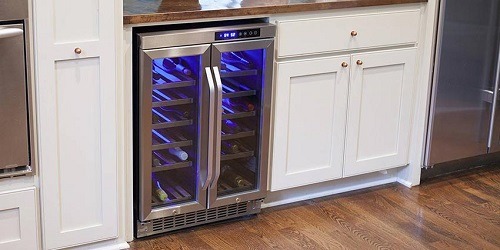
- Avoid hollow cabinets for rear-venting units. A freestanding cooler pushed into a cabinet opening runs hotter and longer, and the cabinet can act like a sound box. Only front-venting, built-in models are designed for that kind of space.
- Add rubber pads. Anti-vibration pads under the feet help a lot on tile, stone or hollow wooden floors.
- Quiet the contents. Make sure racks are fully seated and bottles are not touching each other or the back wall. Nothing should sit loose on top of the cabinet.
When a New Noise Means a Problem
The sound you hear on day one is your baseline. A change from that baseline is what to watch for.
- Grinding, scraping or a rhythmic ticking usually points to a fan blade hitting something or a fan bearing wearing out. Unplug the unit and look for anything touching the fan before using it again.
- A compressor that never stops running suggests the cooler cannot reach its set temperature. Check the room temperature, the vents and the door seal. If it still runs non-stop, see wine cooler not cooling.
- Repeated clicking with no hum after it, where the compressor seems to try to start and fail, can point to an electrical or starting fault.
- Loud buzzing or rattling from the back that is new may be a loose panel, tubing touching the cabinet, or the unit having shifted out of level.
Anything electrical, or anything involving the sealed refrigerant system, is a job for the manufacturer or an appliance technician. If the unit is under warranty, contact the manufacturer before opening panels.
A practical last tip: if the noise mostly bothers you at night, check whether the cooler shares a wall with a bedroom. Walls carry vibration well, and moving the unit to a different wall, with rubber pads under it, often helps more than anything else you can try.